



Two weeks ago, we kicked off the How to Get a Job series, exploring how you might go about your own career planning or job search process. Each week, we explore a few of Tamzin Foster’s recommendations in greater detail.
In today’s issue…
Taking a good long look at the monster under the bed. It can be such a relief to really run with pessimism, rather than trying to suppress our darkest imaginings. What if what we feared really did come to pass? What then?
Why, in family life, we need to ask - not assume. Modern family dynamics are complex. So if you’re, eg, planning on the assumption that you need to be the family bread-winner, it’s probably best to check that your spouse isn’t secretly harbouring their resentment that they’re on the school run, and not a partner in a law firm.
Optimism is probably over-rated.
A reluctance to be the bearer of bad news, to be a “downer,” to call for caution, is behind some of the worst corporate scandals that exist. (For a sobering read on this, try Barbara Einrich’s chapter on ‘How positive thinking destroyed the economy’, in her book Smile or Die).
It can be unpleasant for us to admit that we may or may not have the first idea of what sort of job we’re actually looking for, or to reckon with the possibility that yes, we are going to have to make some changes to the household budget this month.
But to feel obliged to deny the fact? To expend an enormous amount of energy to remain perpetually in stasis? What a phenomenal waste of human potential this is.
It’s not, whatever we might tell other people, “fine.”
Time to bring… the darkness.
The curious appeal of pessimism.
Before I became a coach, I worked with The School of Life, an organisation that takes great and public pride in its pessimistic outlook. It was always interesting to me that we dour Europeans, with a provocatively bleak outlook on life, were so well received in sunny, chirpy California.
Why on earth did they put up with us? Well - firstly, I suppose, we had license to be grim, in a way that much of our American audience didn’t. Exceptions are sometimes made for foreigners.
Secondly, positivity is all very well until it feels phoney. Then… we start to get the “ick”. It’s incongruent to try to pretend that you’re having a great day when actually your world is collapsing around you. It feels rotten. And this kind of inauthenticity can also taint what’s genuinely joyful, until we scarcely know which is which.
This isn’t to suggest that we all become professional doomsayers. To focus only on the negative is as inauthentic as to focus exclusively on the positive.
It is, for example, simultaneously true that: the world is awful, and that it is much better than it once was; and also, that we still have a very long way to go:
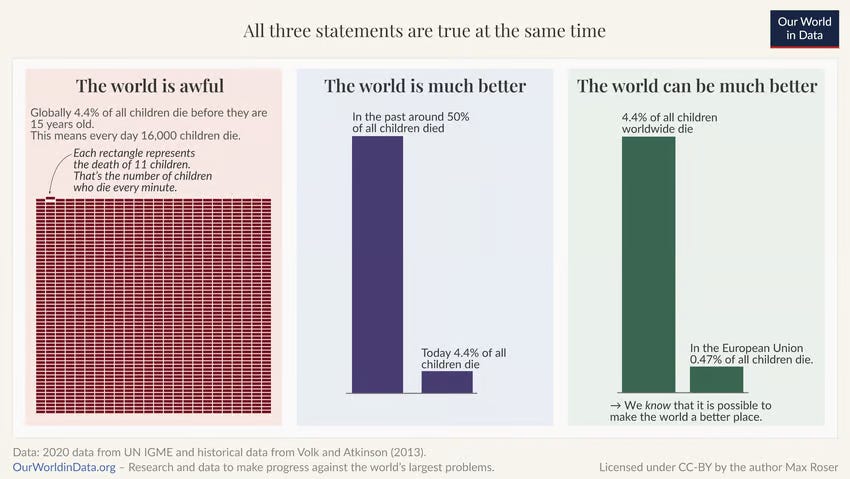
In the face of this, the quiet, dignified expression of distress is really rather attractive. There’s a pleasing directness in acknowledging what is difficult, rather than pretending it does not exist; in offering a balanced assessment not only of the positives but also of the negatives. In short: being distinctly adult in our approach to all that is troubling.
Preparing for the worst.
Whether or not you imagine you’re actually going to end up using them, I’m guessing that most of you are already persuaded that it’s probably a good idea to know where the emergency exits are. I expect you’ve done a few fire drills in your time, too, and actually gone in and out of them a couple of times, just to get the feel of the thing.
In much the same way, many of the great Stoic philosophers thought it was a good idea to sleep on cold stone floors. Some (I’m told) also had a go at eating from the dog’s bowl, just to prove the point that as unpleasant as it was - life would go on!*
Similarly, Seneca recommends having a practice run at deprivation.
Set aside a certain number of days, during which you shall be content with the scantiest and cheapest fare, with coarse and rough dress, saying to yourself the while: “Is this the condition that I feared?” It is precisely in times of immunity from care that the soul should toughen itself beforehand for occasions of greater stress, and it is while Fortune is kind that it should fortify itself against her violence.
The stoics were fans of a bit of “voluntary discomfort,” precisely because it made the uncertainty of life (and the possibility of involuntary discomfort) a bit more bearable. Perhaps people who join Barry’s Bootcamp feel the same way.
Personally speaking – I’m not about to steal biscuits from a labrador. But I do take their point. Especially when, and with rather fewer risks to hygiene, Marcus Aurelius recommends setting some realistic expectations for the day:
Betimes in the morning say to yourself, this day I shall have to do with an idle curious man, with an unthankful man, a railer, a crafty, false, or an envious man; an unsociable uncharitable man.
Or, in other words: yes, you will have to deal with idiots from time to time. This is not a disaster - it’s simply the business of living. In what world did you imagine that you wouldn’t have to?!
Premeditatio Malorum.**
To harness the power of negative visualisation, you might try a ‘meditation on evils’. Depending on your typical propensity for chirpiness, some of you will find this easier than others.
To begin - first, physically remove yourself from somewhere other than where you habitually work, sleep, eat, relax. Set a timer for up to about 20 minutes. Use the full amount of time, and allow your darkest imaginings to run riot. Write them down – especially – and this is important, if they start to seem rather silly or comical.
Put the list away, out of sight, and do something else for at least another twenty minutes, or maybe overnight. Move your body. Put some music on. Eat a really sweet and juicy orange. (Emotions have a lifespan of less than a minute in the body, if they’re not also fuelled by our thoughts. Witness the mercurial qualities of toddlers for confirmation of this fact.)
When you do revisit your list, consider asking yourself:
How reasonable do your fears seem now? How likely?
What might be in your power to change? What is not?
What therefore will you do? Where will you focus your energy? What will you stop?
What if any unexpected benefits might there be?
It’s always worth pondering the question, “But what if it all had to go?”.
Your resilience may surprise you. You might also discover a capacity to live with less, not because you have to, but because you can, and you choose the freedom and flexibility this affords you.
The Pre-Mortem.
You might also like to run a pre-mortem. Which is exactly like a post-mortem, except that you do it when you still have power to change the outcome.
Consider the following questions:
First: what exactly is my worst case scenario? (eg, joblessness? Boredom? Moving to a new area? Moving back in with mum? Gary who worked in accounts 3 years ago thinking that maybe you could have done a bit better?)
What set of circumstances might lead to this?
What could you do to intervene before that happened?
What support would you need to do this? How could you secure that?
If it is not possible to avert disaster, what would make the worst case scenario more bearable? (eg, ask mum very sweetly if you can update the Take That wallpaper in your old room?)
In family life: ask, don’t assume.
As well as having a dry-run at disaster, negative visualisation also encourages us to focus on what’s within our control: ourselves. Once we take the very worst for granted, we can no longer avoid the central question:
“Okay – so what shall we do about it?”
Working dads are especially vulnerable to the notion that their options are more limited than they in fact, are.
This shouldn’t surprise us. Dads all around the world are radically rewriting the script on what fatherhood can look like, and in fact: 70-90% of men feel as responsible for care work as women. But they do this in continual tension with the early model of fatherhood that they inherited from the previous generation. They may make an active choice to do things differently, but their earliest notions of family life – what feels instinctively “right” (however progressive an adult they may be!) – is often very different. The pressure to provide is intense, and occasionally, so punishing, that it becomes an existential crisis.
What’s workable for any one particular family may look a bit more traditional (eg, with a male breadwinner) or rather less traditional (eg a 50-50 split on everything, or a stay-at-home dad). It may be a pattern you’ve “fallen” into, it might be consciously chosen. (For more on this, check out the article on working family partnerships).
But you have options.
The new model of fatherhood is complex. A movement away from traditional roles means that “everything is a negotiation.” And that takes thought, and work.
It’s also richer, more varied, and likely to be much more satisfying. It’s also more secure. You have, to put it one way – diversified your stocks. When I interviewed working dads on the subject, one told me: “it’s not about being the only one who can do something… we share the load. And that makes it richer. When we’re getting the support of people around you, for children or adults really, getting it from multiple sources has to be better.”
With changing and expanding roles for both men and women, dividing your shared responsibilities, and working out how everyone contributes really is more challenging than ever. Yet the choices we’d rather not make, the conversations we’d rather duck, are so often the ones we most need to have.

So. Don’t assume the rules of the game. You might like to consider the following:
What was the model of working parenthood that you received in your own childhood? That you observed in the wider world?
In what ways does that work for you, or not?
Turning to your personal values and aspirations: what is it that you are shooting for? What priorities do you have? What are you aiming to protect?
Add richness, detail, and specificity, so you know when enough is enough. If wealth is important to you, that’s great to know. But how much? What for? What would be the next best alternative?
Now articulate them. Share them with your partner. What’s the overlap? The areas of work? The assumptions that you need to revise?
How can you build a shared plan for which you will both be responsible? How will your contributions differ, and match one another?
Check in with your partner. Maybe it’s their career moment, not yours. Maybe not. Maybe both.
The conversation is worth having either way.
*I confess that this particular reference eludes me. Classicists: please apply.
**Once more - I fear this may be a pseudo-Latin coinage. But lack the training to argue it.
Other articles in the ‘How to get a Job’ series:
How to Get a Job.

'How to Get a Job' - Part 1
11 recommendations for job-seekers, based on my coaching experience.
Urgent Memo: Stop Work.

'How to Get a Job' - Part 2
1. Recognising the self-soothing behaviours that are, actually, miserable
2. Learning to recognise joy
Letting it all hang out. (Sometimes.)

'How to Get a Job' - Part 4
5. Writing the 'antidote to the one-page CV'
5. Considering not only your strengths, but your enthusiasms.