



I really dislike the concept of ikigai. Or rather, probably not the original Japanese concept, which I can’t claim any real knowledge of, but the Western interpretation of it, and all those complicated Venn diagrams. You know the ones: lots of overlapping circles in tasteful colours and a purposeful, fulfilling career (life?) sat somewhere in the centre of it all:
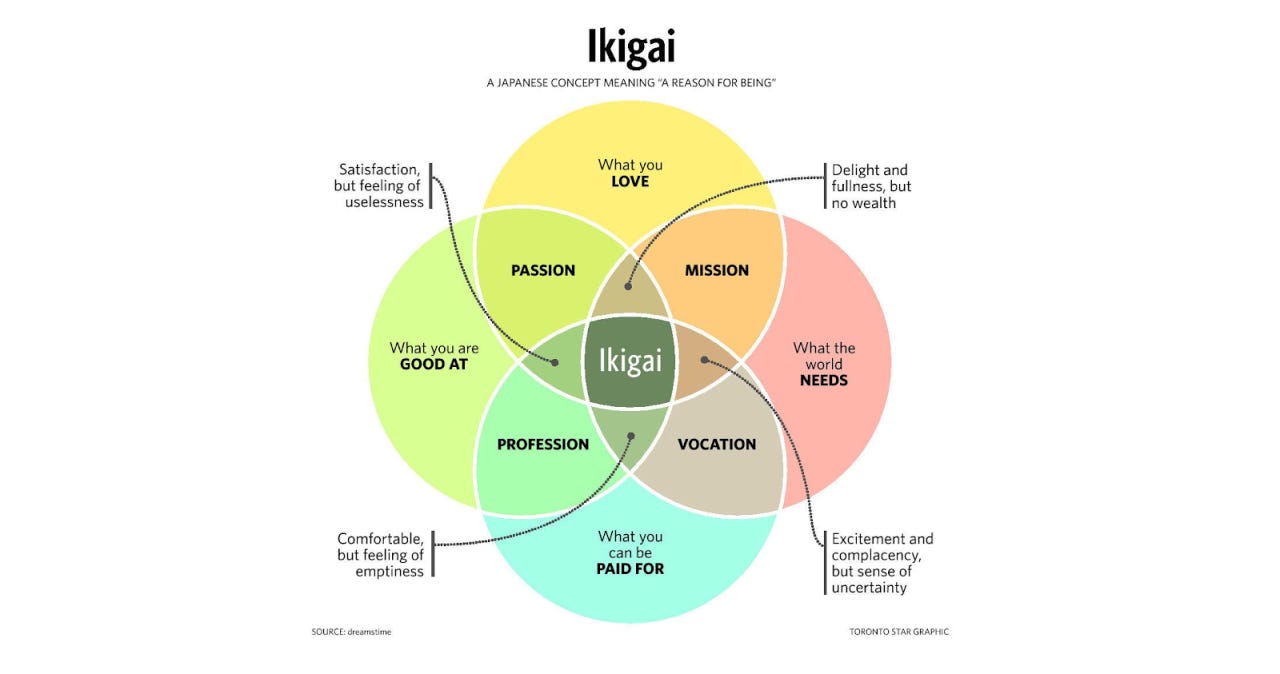
I dislike it, because the implication is that the “answer” is singular and neat, when in reality, we’re probably solving for different things in different seasons of our life, all in a rather messy and imperfect way, and that for many of us, struggle is inevitable.
So there’s that, and also the fact that it looks very impressive, got someone a book deal, probably does have a fair bit of merit after all, and worst of all: I didn’t come up with it.
Given all of the above, I tend to suggest a different exercise for my career coaching clients, and it’s one that you can very easily play, too. It’s a good one for dinner with your partner or a pub date with friends. Like a Cosmo quiz with bite.
It starts with a question.
“What would you do… if you were only solving…
…for Money.
If you stripped back every other consideration – such as interesting and satisfying work, bedtime with the kids, your spouse’s patience – what would you choose, purely to maximise your income, given your skills, capabilities, and so on?
(Handy to know it’s there, even if you’d really rather not.)
…for Social Cachet.
In other words, because it sounds good at parties, or on a first date.
(I’ve worked in a few very “cool” places, that were mad as a box of frogs on the inside. But they did make a great answer to the question, “so… what do you do?”*)
…for Social Good.
Whatever your personal definition of doing good for others looks like, if you were picking for this and this alone, what would you do?
Don’t stop at “working in a charity” – be specific. Is it a major children’s NGO, or a donkey sanctuary? Is it even a charity at all?
Perhaps it’s becoming a midwife (goodness knows, the country needs them) or a care home assistant, or spending your weekends picking litter out of hedgerows, or nursing injured bats back to health. (I have met this lady; she was gloriously fulfilled. And clearly the recipient of a LOT of bat memorabilia from friends and family.)
…for Intellectual Challenge.
Now consider what you’d do if exercising your mind was your sole concern.
And since we’re exercising it, let’s not stop at “become an academic.” (In what department? With what research focus? Teaching or publishing, primarily?).
It might also involve – learning a new language and working abroad, compiling crosswords for The Times, building a business, becoming self-sufficient.
…for an Easy Life.
A oft-neglected, but important option, this – but what’s your idea of an easy life?
(This, like everything else – is highly personal and specific. Though a bike shop serving cappuccinos seems to be relatively popular amongst certain of my clients.)
…to Please Your Parents.
Since it’s there anyhow, and best acknowledged.
It could entail misery. Or perhaps mum and dad really do know best, and it’s perfect for us. Maybe we simply haven’t thought about it too much before now.
The aim here is neither to rebel on principle, or to conform by default – but simply, to see it for what it is, and weigh it amongst the options.
…to Impress the Kids.
And looking from the other side… maybe that’s firefighting, or becoming a pilot.
It could also look like always being free for a kick-about on Friday afternoons.
…for Hedonism.
Perhaps you’ll be a sky-diving instructor, take a sabbatical to travel, buy a vineyard.
In my case: I’ll see you at my beachside tiki bar.
…for the Sheer Hell of It.
See such examples as, sheep farming in the Orkney Isles, or for me? plastering. (The beautiful smoothness of it, the wet slap of plaster that slowly solidifies. The mess of cabling it conceals. I eagerly await a renovation opportunity.)
If you’ve got this far: I hope you paused for a second or two along the way to answer each question for yourself. (No? Go back before you continue!)
This game is firstly – a lot of fun.
The “point” of it, is that – well, for one: we might uncover identify some job titles that are of genuine interest. More likely, you’ll get a sense of the themes and attributes of what a fulfilling career might include, and shed a bit of light on the priorities that are most important to you at this moment in time. (It doesn’t have to be that way forever; just at this particular juncture.)
Secondly, though, will be the more important realisation that generally speaking we really don’t have too much trouble answering these questions. It feels easy and fun, in a way that “what do I want to do with my life,” doesn’t.
The latter is simply too big a question to decide a) forever, and b) all in one go. Think of all the things you’re looking for from a career. A decent income, working conditions that suit you, colleagues you like and respect, interest and enjoyment, progression, learning, a weekly schedule that suits… it goes on. You simply cannot hold all these factors in mind at once, weigh them all, and come up with excellent new ideas all at the same time.
So don’t. I daresay that almost everyone reading this knows the golden rule of a good brainstorm or workshop session: if you’re trying to generate ideas, you need to suspend critical thinking for a bit. You don’t allow naysaying until you’ve got not just 1 idea, but 30. It’s very difficult impossible to be creative while simultaneously telling yourself, “well, that’ll never work.”
You already know this. You don’t put tender green shoots out in the frost. But what’s the first thing we tend to do when thinking about our career? We check the job-listing page. We say, “there’s no way I could pay the mortgage on that salary”, or “I’d have to relocate,” or “I just don’t have those qualifications,” or “it feels like a step back.”
It’s too early in the process for critique.
Instead? Let’s play.
* This is an entire coaching conversation in its own right. I enjoyed Katherine Ormerod’s alternative question, in one of her many excellent articles: “how do you spend your time?”. I like to add “at the moment” to my own versions, in a subtle / pedantic distinction between what we’re currently occupied with, and who we are.