


A few months back, former entrepreneur, current VC-investor and political dabbler Marc Andreessen (net worth, billions) cheerfully described his position on introspection to David Senra. It consists of doing “as little as possible” of it. Ideally, “zero.” His entire philosophy, apparently, is “Move forward. Go.”
(At which point, I was already wondering, uh… where? Is the weather nice? Etc).
He added to this a few bonkers historical claims (namely: that introspection was invented in the early 20th century, and didn’t exist before that), and conflated introspection with a kind of guilty rumination (which is a suggestive leap for his personal psychology). In response to the backlash, he then spent several weeks of ironically-charged effort in exploring and defending his ideas (!), on X of all places.
(Which prompted my next question: which particular horror makes introspection so acutely painful to the poor man?!)
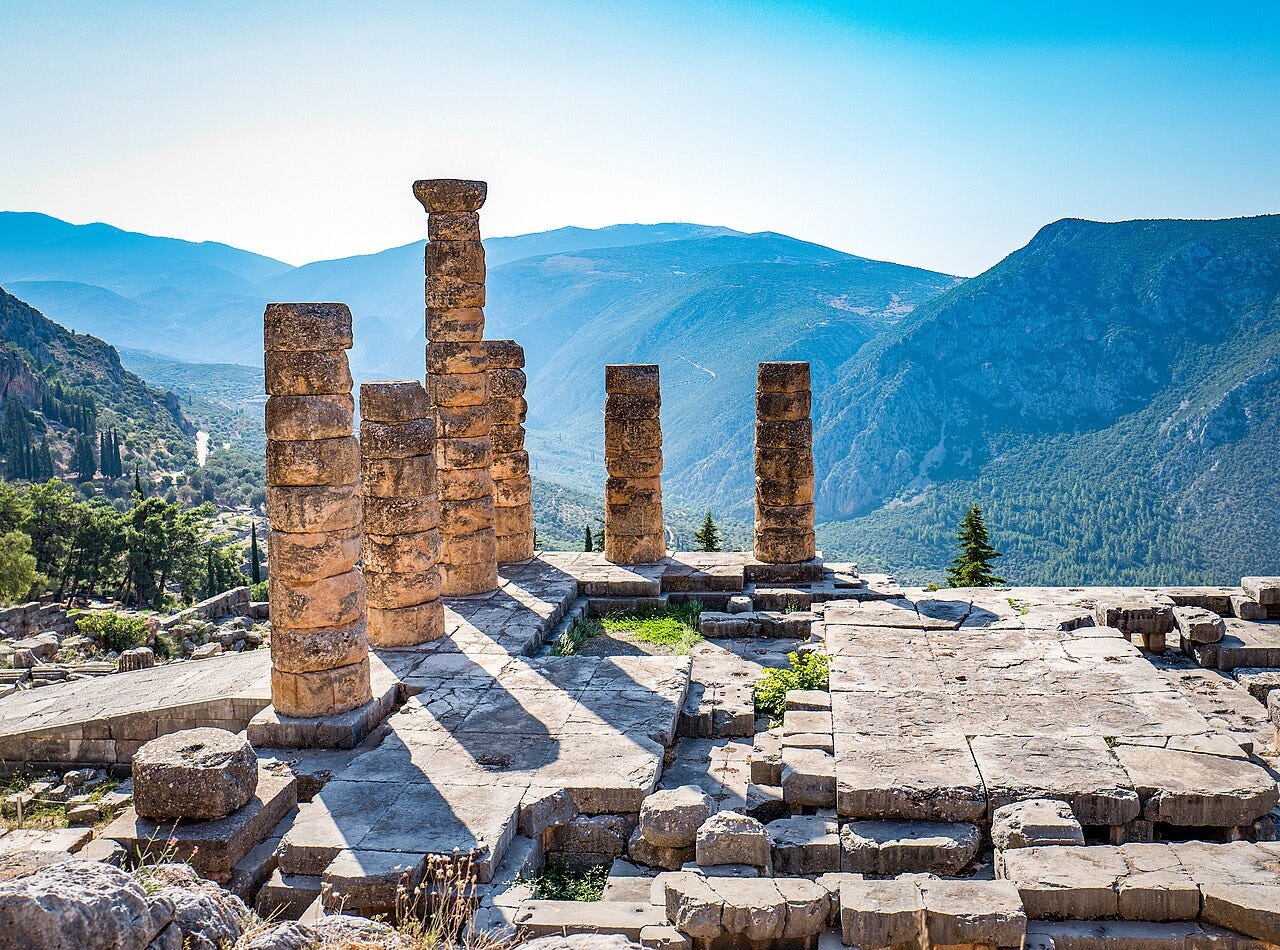
Andreessen is factually inaccurate on … oh, so many points, but particularly the idea that introspection was “invented” by the likes of Freud et al in the early C20th. (Critics, better read than I am, point in significant detail to the likes of: Socrates, Marcus Aurelius, Augustine, Montaigne…). For example. The injunction, “know thyself” predates Socrates, and was carved on the temple of apollo at Delphi, around 6 hundred years BC. Which makes Andreessen approximately two and a half thousand years out of date.
A great leap forward for humanity.
And that’s just a sample of Western philosophical tradition.
Karl Jaspers wrote about the ‘Axial Age’ – a period between around 800 and 200BC, when all around the world their appears to have been a great surge forward in human thought, about thought: in consciousness, in self-reflexivity. Confucius in China; the Buddha in the foothills of modern Nepal; the prophets Isaiah Jeremiah and Ezekiel in the Hebraic tradition, the pre-Socratic philosophers in Greece. It’s a curious coincidence, and Jaspers suggested that perhaps the advent of introspection as a discipline was some kind of great developmental leap forward for humans at the species level, in the same way we might think of things like fire; metal working; democracy; the industrial revolution; AI.
So no, introspection was not invented in Vienna somewhere between World War 1 and World War 2. And funnily enough, failing to realise that is itself a failure of… introspection. As Douglas Adams so beautifully put it in The Salmon of Doubt (a wonderfully funny book, and a much better way of spending time, if you ask me, than hysterically entrenching one’s opinions on X):
“Anything that is in the world when you’re born is normal and ordinary and is just a natural part of the way the world works. Anything that’s invented between when you’re fifteen and thirty-five is new and exciting and revolutionary and you can probably get a career in it. Anything invented after you’re thirty-five is against the natural order of things.”
Despite apparently reading a bit of Nietzche, which is no easy feat (but apparently; not all the important bits), Andreessen cannot see that introspection is not “new” because he fails to see the systems of thought and philosophical traditions of which he himself is a part.
Sight, and self-sight
If you can’t see the raw material and scaffolding of your thinking, you can’t see the assumptions that may need to shift, and you can’t see the emerging reality. You get stuck.
Now that really set my curiosity afire, because “the capacity to sense an emerging reality and to act in harmony with it” tends to be identified as a distinctly entrepreneurial ability. That quote is from Presence, Senge et al. The founder-CEOs I’ve worked with intuitively identify the same ability, and I know CEO coaches who’ve written entire workshops on this point alone.
This ability is also common to many artists and to creative vision. Michelangelo might see a hand emerging from the marble. An entrepreneur might spot a consumer trend and a solution others couldn’t.
Now clearly, Andreessen has been “successful” in that he’s made an eye-watering amount of money, and, as capital tends to, such lucre has compounded. But that doesn’t necessarily mean that he has successfully integrated a previously successful strategy (a good decision) into a future-fit process (the ability to make great decisions on an ongoing basis). Thank goodness, then, for compound interest.
Far from moving forwards, Andreessen is doing what a lot of wealthy folks do, and defending what he has. A blind spot, after all, is the defensive move par excellence of the self.
Capitalism provides the forward motion. Andreessen is along for the ride; eyes wide shut.
Success indeed.
What we can see, what we can’t
The evolution of the self, and what’s achieved through introspection, is something I’ve been reflecting on a lot lately, which is probably why encountering the Andreessen video made me snort coffee out of my nostrils.
You have to be able to see the self, to be able to work with it. Observing the vantage point from which you’re doing the observing, while you’re doing it, is very difficult, which is why we tend to need a bit of “reflection-on-action” as well as “reflection-in-action” (Schön).
There are some moments when we are able to simultaneously act, and observe with a a non-judgemental openness what’s going on for us, but since that takes a bit of mental gymnastics / practice, it’s relatively rare. Kegan suggests that you can only work with what is object rather than subject, which is why stepping back, from time to time, is useful. Hence away days, retreats, taking a walk about the block, coaching etc. You might see this referred to occasionally as “suspension,” which is a nicely apt bit of phrasing for the mechanism of what’s going on here.
In other words; a relentless pursuit of forward motion might inhibit growth.
I’d extend the developmental perspective from Kegan here with reference to the Buddhist concept of anattā, which suggests that any notion of a stable self is an illusion. This is the sort of thing that is very easy to say and very hard to achieve, but I suspect that if you do achieve it, reflection-in-action becomes a whole lot easier, and, in effect, becomes a whole new way of being.
Navel-gazing
A generous read is that Andreessen is worried about a whole lotta navel-gazing. And fair enough, I say, but probably still not a reason to recommend “zero” reflection, for the reasons above. Unless you’re already a Buddha (and honestly, I’m not sure Andreessen is a candidate), you’re going to find it really hard to observe the self while, well, self-ing.
If we take the view that “self” is created, can be developed, and continues to be created through the habits conscious and unconscious that we create (which I believe is true; a probably essential belief for the work I do), it stands to reason that although viewing self as object through a process of suspension can be helpful, it’s also not “true”, simply - expedient. Who we are is a living, evolving notion shaped moment to moment. We can’t discover it “out there”, catalogue it, stick it in a museum. We can only encounter it.
Which means that the encounter with the self is not only in retreat, but action. Both fields, suspension, action, are needed. (To invoke Marcus Aurelius once more; it’s an absurdly weak claim to imagine that the Meditations got in the way of his running the Roman empire, managing military campaigns etc. Reflection and action go hand in hand.)
Andreessen seems to assume that self-reflection would lock us in place, trap us in a bunch of futile navel-gazing, and prefers to run, at full tilt, instead. Both are responses driven by panic.
For most of us, self-reflection supports motion towards a desired future, rather than just scattering at speed. Introspection doesn’t condemn you to inertia. It gives you a say in which way you’re headed.
But that might depend on what you find there, and whether you can bear to look.
The identity-based lock-in
I’ve written before, on the subject of praise, to consider why even a positive identity label can backfire. It’s worth revisiting.
Self-labels can occasionally be helpful. If I tell myself I’m an athlete and set about my exercise plan accordingly; that could be useful in helping me achieve that aim. But while that might spur and support a positive self-concept, it’s also a profound reduction of all that a human soul is and could be. And that can sometimes create problems of its own. Let’s imagine I tear my Achilles. Who am I now? A setback can all too easily become an existential crisis. (I’ll offer another, which may cut deeper: what if I always pictured myself as a mother, and now cannot conceive…?)
The identity-labels we’re offered by other people are particularly risky, because we’re privy to far less of their context, their conceptual scaffolding. We don’t see the reductions and simplifications they’ve made to get there in quite the way we might be able to do for ourselves. Tell me I’m lazy, or unconfident, and it’s not just a verdict, but a self-fulfilling prophecy. Tell me I’m someone who is a “born operator” and you handicap the emerging strategist.
That’s why when we give feedback, we aim to describe the behaviour, to share with someone the impact they have for you, rather than attempting to tell them who they are. Firstly, you can’t, and to suggest you can is an act of hubris; secondly, even if you could, it’s almost certainly a very bad idea.
Want a growth mindset? Then focus on growth in all its increments, not the “entity” of self.
You are, after all, the choices you make.
Thank you for reading.
I do so hope you enjoyed the latest post. If so, you may wish to check out the following related articles from the back-catalogue (also linked above).


As ever, I love hearing your thoughts and responses. Do reach out to tamzin@fuseco.uk or comment below - I respond to every one.
T. x
This was a fun read. Made me think of Francis Weller’s description of the self as “more verb than noun” - something with fluidity and movement, not static. Likewise Nora Bateson in the self-as-verb space; as in, “how am I Tamzin-ing today?”. Offers such a hell of a lot of conceptual space and room for evolution.