



Resuming the How to Get a Job series, which explores how you might go about your own career planning or job search process. Each week, we explore a few of Tamzin Foster’s recommendations in greater detail.
In today’s issue…
Writing the antidote to the one-page CV. Before you spend time cutting your life down to a single side of A4 and presenting it for someone else’s approval, its best to recollect that this is not a summation of your worth as a human being. Buttress your sense of self. (Proust ran to 7 volumes, which might be adequate.)
Considering not only your strengths, but your enthusiasms. E.g. I consider that my husband is good at washing up. But this is not, apparently, what he wants to be famous for. Beware praise. Other people may have your best interests at heart – or maybe they just want the proverbial washing up done.
Self-editing.
Anyone who has ever written a CV knows that editing can be a… painful process.
I’m not looking for a job. And yet every visit to LinkedIn comes with a slew of tips promising to make me more professionally appealing to others. There are, it seems, all sorts of ways to carefully select, rehearse, and engineer aspects of myself to best ensnare a recruiter - be they human or otherwise.
And, if I really want to, I can also create an image of myself that comes ready-airbrushed: dark circles and blemishes not simply erased, but never there to begin with. This new me will also be at least a stone lighter than I actually am - and achieved in a mere moment by a computer programme that, until recently, wasn’t sure how many torsos to include, and even now that it can get that right, doesn’t care either way.
Perhaps some people enjoy the improved, oh-so-svelte versions of themselves. (Personally, I find figures that don’t seem to include a skeleton rather disturbing). But at least in my case, it’s more or less harmless - if only because I’m so profoundly bored by this sanitised version of reality.
However. Slimming down can become rather more harmful if you’re job searching.
We know that attention spans are short. That the competition for the most desirable jobs is intense. And so we reduce and edit ourselves down to an impossibly flimsy, but shiny and brilliant self… all for someone else to review, and approve.
And if they do not approve it?
We’re left with very little from which to rebuild.
Simply put. It should be obvious that one side of letter paper in double spaced text is vastly inadequate to describe your worth as a human being.
Nor is it enough for an expression of all that you are and feel: for your loves, your losses, your hopes and dreams, your fantasies, your joy – and yes, for the “uglier” feelings too – for your rage, your envy, your bitterness, your deep-seated sadness, your fears.
We need more.
You are not a brand.
From time to time, it may be necessary to carry out a branding exercise in which you work out exactly how to present yourself to best effect. And look, I think we can all agree that your job interview is not therapy.
But equally, you are not a brand.
‘Letting it all hang out’ is not a strategy I recommend for all situations, all of the time.
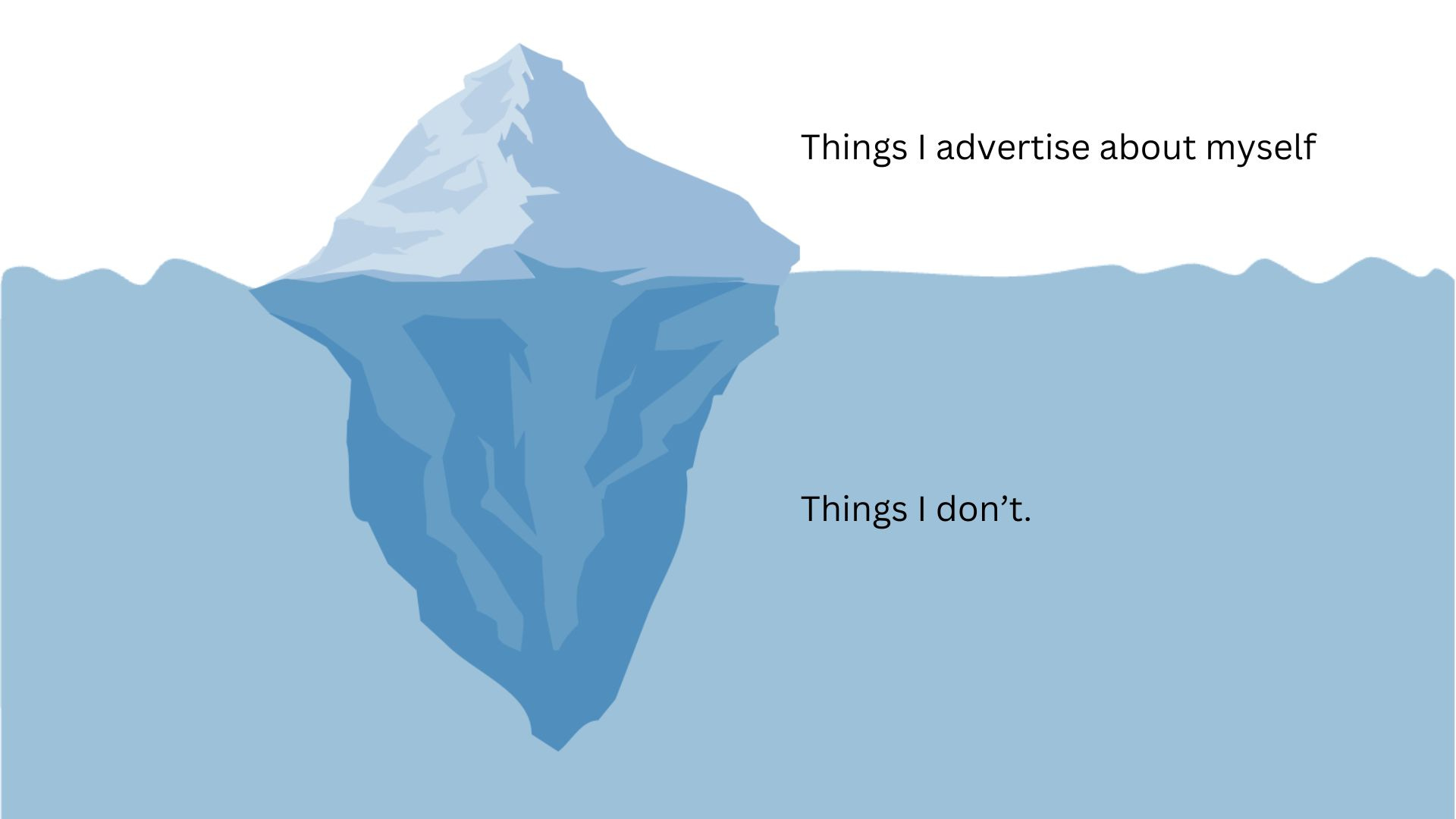
It’s true that the “iceberg effect” of self-knowledge can make life challenging for all of us all from time to time. Since you are better acquainted with your own flaws, than the flaws of other people (because it’s not in our interests to advertise them), the availability bias can lead us to conclude that other people are less flawed than we are.
That doesn’t mean that you should take personal responsibility for advertising your flaws in detail to the world at large, least of all a recruiter, in order to redress some kind of societal imbalance.
It just means that we need to find a safe, appropriate space in which we can explore our unedited self. To escape perfectionism, to have a chance to explore what exists at the margins (which do often turns out to be the source of inspiration & creativity), to stop pleasing others and instead ask what would please ourselves.
That could be (in no special order):
The company of a trusted friend
Therapy
Coaching
A pub? (Do we all still go?)
Journaling
Primal screaming
At a nudist beach
A moonlit mountain-top
…you get the general idea, I hope.
The antidote to the one-page CV.
I particularly recommend writing your very own ‘antidote to the one-page CV’. Or in other words, an autobiography. Marcel Proust’s A La Recherche du Temps Perdu ran to about 7 volumes, so hey: go wild.
If that kind of verbiage doesn’t come so easily to you, and you’d like some pointers, try writing a brief personal history, that includes the key events and challenges of your life, from your earliest memories to the present day. (Charles Dickens’ David Copperfield opens with, “I was born…” and Tristam Shandy went back as far as his own conception. So however you want to do it - there’s precedent). By all means include the key events of your career too, and how the events of this unfolded for you. But since this record is for you, not anyone else – tell it as you wish, rather than bathed in the golden glow of hireability.
Writing in this way can show you much that might otherwise be hidden when we spend too long in the edited version of reality.
Partly it’s about acknowledging our own complexity, and allowing the existence of our shadow sides. It’s also about learning to pay attention to the patterns and motivations of our own lives.
The CV as mental framework.
Whilst recognising that CVs serve a very particular purpose, I also tend to think that writing them trains us to think in ways which can be unhelpful.
As discussed already: they’re highly edited and a very poor record of a human soul.
They’re backwards-looking, and so spending too much time with them leads us to focus on who we were, not who we’re becoming.
And finally, they talk a lot about what we’re good at.
I do realise that the this is what we could call, ‘functioning as designed.’
CVs are not supposed to communicate our essential human worthiness. Your track record and talents are useful things for a potential employer to see. But this is not the mental model that helps you to plan for a fulfilling career.
Enthusiasms, over strengths.
Whilst it can be somewhat helpful to know what you’re good at, this isn’t by itself, enough. Especially, beware praise (which is difficult to remember, when we want someone to give us a job).
For example. I happen to think my husband is an expert-washer-upper, and I’d like him to do more of it, whereas he does not. It’s helpful to know what other people appreciate in us, and what they think we do well. But we also need to consider what is enjoyable and energising to us. You can be a wonder with the scrubbing brush but have no desire to be famous for it.
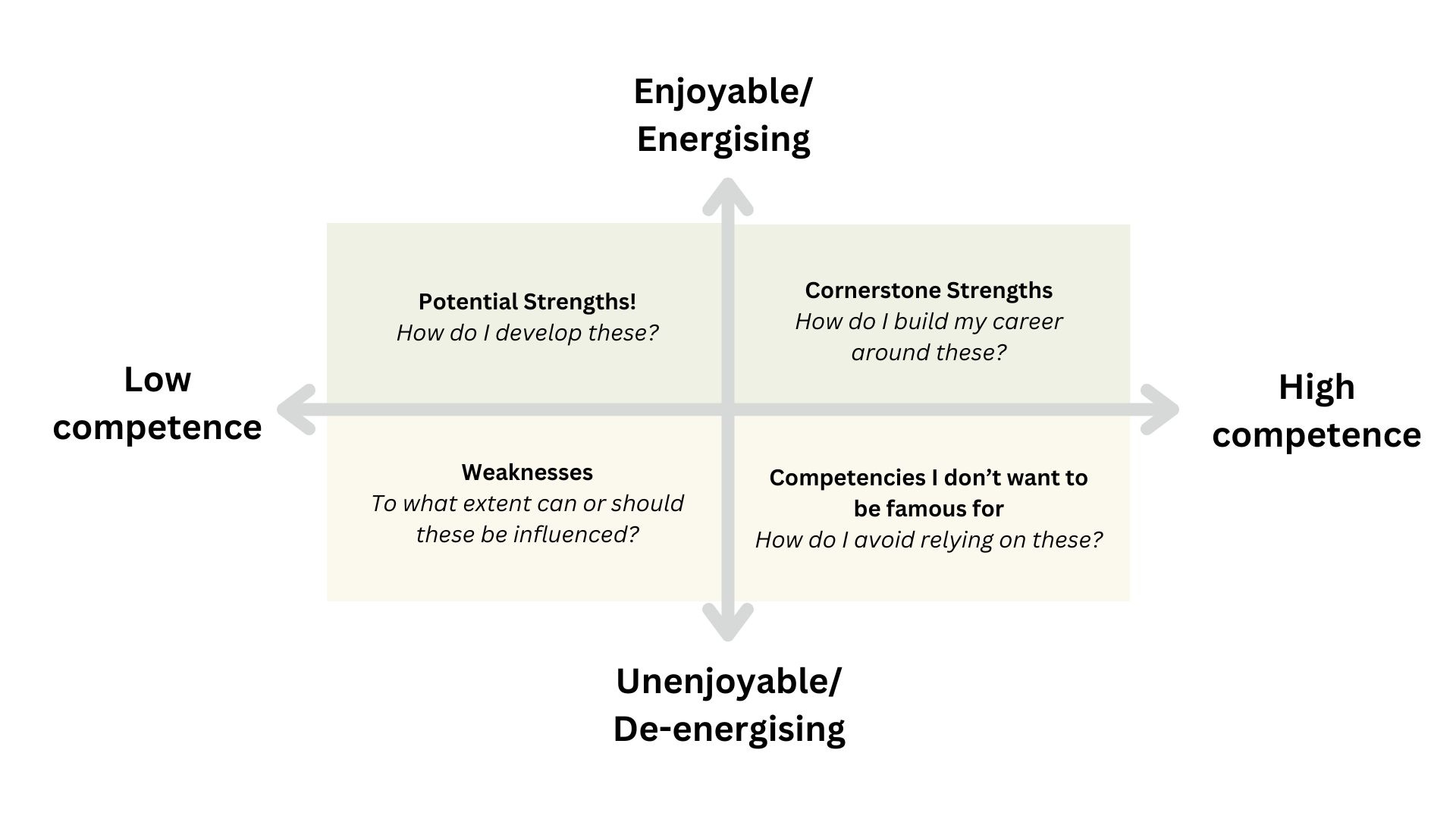
On the other hand - I am an enthusiastic, if non-expert, dauber of paints. But given that I love doing it, mixed results aside, it’s likely that I can become really quite a lot better, fast.
Not sure what it is you are drawn to?
Handily enough, you just wrote your own life story. Time to make a cuppa and have a good long read.
In the words of Oscar Wilde:
“I never travel without my diary. One should always have something sensational to read on the train.”
It’s time to get acquainted with the fullest, most joyously complex version of ourselves, in glorious technicolour detail.
Do keep the replies coming - they are a joy.
I promised a week’s interval last time around and was unable to keep pace. Partly because of, (or despite?) some reflections on Productivity which came out under the FuseCo. banner and which you can check out here.
Next time around (I won’t say “next week,” just in case) - we will continue the theme of How to Get a Job, and consider how to make peace with not having universal appeal, and how to get really explicit about what you’re solving for and the trade-offs you’re prepared to make.
Thank you for subscribing.
Tamzin x


